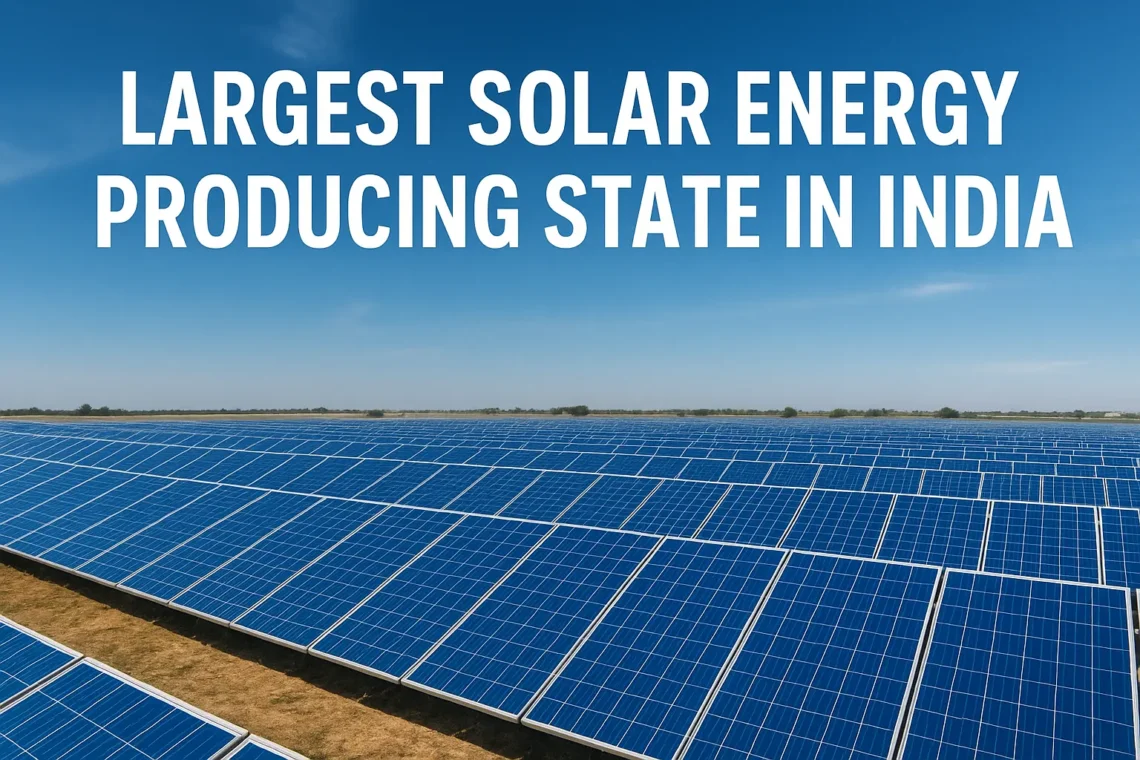

India’s solar energy story has moved from ambition to action over the past decade. As the country pushes toward energy security, lower emissions, and affordable power, one question keeps surfacing in policy debates, classrooms, and investor meetings alike: which is the largest solar energy producing state in India, and how did it get there?
This topic matters right now because solar power is no longer experimental in India. It is a core pillar of national energy planning, influencing electricity prices, land use, employment, and climate commitments. Understanding which state leads the solar race helps explain broader trends in infrastructure development, governance, and technology adoption.
In this full analysis, we look beyond a simple ranking. We explore capacity, policy support, geography, grid integration, and future potential to understand what truly makes a state India’s solar powerhouse—and what lessons others can learn.
Understanding Solar Energy Production in India
How solar power capacity is measured
When we talk about the largest solar energy producing state in India, we are usually referring to installed solar capacity, measured in megawatts (MW) or gigawatts (GW). This figure reflects how much electricity solar plants can generate under ideal conditions, not how much they produce every hour of the year.
In simple terms, installed capacity is like the engine size of a car. A bigger engine can produce more power, but actual output depends on how and where it’s used. In solar energy, sunlight availability, panel efficiency, and grid connectivity all influence real-world generation.
Key elements used to assess capacity include:
- Total installed solar power (utility-scale + rooftop)
- Land-based solar parks versus distributed installations
- Grid-scale versus off-grid systems
- Year-on-year capacity growth
For example, a desert state with vast open land may host massive solar parks, while an urbanized state may rely more on rooftop installations. Both contribute to national totals, but utility-scale projects often dominate rankings.
Why state-wise solar rankings matter
State-level comparisons are not just academic. They directly affect investment flows, policy replication, and national planning. When one state emerges as the largest solar energy producing state in India, it becomes a testing ground for regulatory frameworks, land acquisition models, and public-private partnerships.
These rankings also matter because electricity is a concurrent subject in India. States control land, local approvals, and distribution companies. A strong solar-performing state often signals smoother clearances, better grid readiness, and more predictable policy environments.
A practical example can be seen in how other states copy successful solar park models or auction structures pioneered by leading regions. In that sense, the top solar-producing state shapes the future of India’s renewable roadmap.
Rajasthan: India’s Largest Solar Energy Producing State
Installed capacity and flagship solar parks
As of recent official data releases, Rajasthan stands as the largest solar energy producing state in India in terms of installed capacity. The state has crossed several gigawatts of solar installations, largely driven by vast utility-scale projects spread across its arid districts.
Rajasthan’s dominance is closely tied to massive solar parks such as:
- Bhadla Solar Park, one of the largest in the world
- Jaisalmer and Jodhpur solar clusters
- Large privately developed grid-scale projects
In plain language, Rajasthan has space—and lots of it. The state’s desert geography allows developers to build large projects with minimal land-use conflict. Combined with high solar irradiation levels, this creates ideal conditions for consistent power generation.
Key impacts of Rajasthan’s scale include:
- Lower solar tariffs due to economies of scale
- Faster project deployment timelines
- Strong attraction for domestic and foreign investors
A real-world use case is interstate power supply. Solar power generated in Rajasthan often feeds into the national grid, supplying electricity to states with higher demand but less generation capacity.
Geographic and climatic advantages
Geography plays a decisive role in making Rajasthan the largest solar energy producing state in India. The state enjoys some of the highest solar radiation levels in the country, with clear skies for most of the year.
Climatic advantages include:
- High solar insolation across western districts
- Low rainfall, reducing panel damage and downtime
- Flat terrain, simplifying construction and maintenance
From a technical perspective, higher insolation improves capacity utilization factors (CUF), meaning plants operate closer to their maximum potential more often. This improves project economics and investor confidence.
An accessible analogy is farming. Just as certain crops thrive better in specific climates, solar panels perform best where sunlight is abundant and predictable. Rajasthan offers that environment at scale, giving it a natural edge over many other states.
Gujarat’s Solar Leadership and Close Competition
Early adoption and policy innovation
While Rajasthan currently leads, Gujarat deserves special attention for its pioneering role. The state was among the earliest to adopt large-scale solar policies, long before solar power became cost-competitive nationally.
Gujarat’s early Solar Power Policy helped:
- Attract private developers ahead of other states
- Build administrative expertise in renewables
- Create early grid-integration frameworks
Although Gujarat may rank slightly behind Rajasthan in total installed capacity, it remains a strong contender for the title of the largest solar energy producing state in India when broader metrics are considered.
The state’s proactive governance created confidence at a time when solar was still viewed as risky. That early momentum continues to pay dividends today.
Rooftop solar and distributed generation
One area where Gujarat stands out is rooftop solar adoption. Unlike desert-heavy states focused on mega parks, Gujarat has aggressively promoted decentralized solar systems on homes, factories, and public buildings.
Key features of this approach include:
- Strong net-metering policies
- Subsidies for residential installations
- Industrial rooftop adoption in manufacturing hubs
A practical example is textile units generating their own daytime power, reducing grid dependence and electricity bills. This distributed model adds resilience to the energy system and reduces transmission losses.
From an editorial perspective, Gujarat shows that leadership in solar is not only about land size. Policy design and citizen participation can sometimes matter just as much as geography.
Tamil Nadu and Karnataka: Southern Solar Powerhouses
Industrial demand driving solar expansion
Southern states like Tamil Nadu and Karnataka may not top the charts individually, but they remain critical players in India’s solar ecosystem. Their growth is driven less by deserts and more by industrial and commercial demand.
Both states have:
- Strong manufacturing bases
- High daytime electricity consumption
- Progressive renewable purchase obligations
In simple terms, factories need power when the sun is shining—making solar a logical fit. This demand-pull dynamic has accelerated installations even in areas with less open land.
A real-world use case is IT campuses and industrial parks running large rooftop and captive solar plants to stabilize long-term energy costs.
Grid integration and hybrid projects
Southern states have also experimented with hybrid renewable projects, combining solar with wind energy. This balances variability and improves grid stability.
Notable developments include:
- Solar-wind hybrid parks
- Improved forecasting systems
- Storage-linked pilot projects (reported, limited scale)
While these states may not currently hold the title of the largest solar energy producing state in India, their technical innovation influences national standards. In many ways, they act as laboratories for the future of grid-scale renewables.
Policy, Investment, and Central Government Support
National missions shaping state outcomes
No state’s solar success exists in isolation. Central initiatives like the National Solar Mission, production-linked incentives, and competitive bidding frameworks have shaped outcomes across India.
Key policy drivers include:
- Reverse auctions lowering solar tariffs
- Inter-state transmission incentives
- Viability gap funding for large parks
States that align closely with these frameworks tend to scale faster. Rajasthan’s rise, for instance, reflects strong coordination between state agencies and central ministries.
Private investment and global interest
Large-scale solar projects require significant capital, and India has attracted global interest in recent years. International funds, pension investors, and energy majors are heavily involved—particularly in states with stable policies.
For investors, the largest solar energy producing state in India offers:
- Proven project execution track records
- Grid connectivity assurance
- Predictable regulatory environments
A practical example is long-term power purchase agreements (PPAs) signed with central agencies, reducing off-taker risk and enabling lower financing costs.
Challenges Facing India’s Top Solar States
Land, transmission, and grid constraints
Even the leading states face structural challenges. Rapid capacity additions sometimes outpace transmission infrastructure, leading to curtailment risks.
Common issues include:
- Delays in transmission line commissioning
- Land acquisition disputes in non-desert areas
- Seasonal demand-supply mismatches
These constraints remind us that being the largest solar energy producing state in India is not just about building capacity—it’s about integrating it smoothly into the power system.
Environmental and social considerations
Large solar parks also raise environmental and social questions. Water use for panel cleaning, local livelihoods, and biodiversity impacts are increasingly part of public discourse.
Reported responses include:
- Dry-cleaning technologies
- Community development programs
- Improved environmental assessments
Balancing scale with sustainability will define the next phase of solar leadership in India.
The Road Ahead: Who Will Lead in the Next Decade?
Future capacity additions and storage
Looking forward, leadership may shift as storage technologies mature and land constraints grow. States investing early in battery storage and grid flexibility could gain an edge.
Probable trends include:
- Co-located solar-plus-storage projects
- Repowering older solar plants with efficient panels
- Greater emphasis on rooftop and urban solar
These changes may reshape what it means to be the largest solar energy producing state in India.
Lessons for other states
Rajasthan’s rise offers clear lessons: leverage geography, streamline approvals, and scale quickly. Gujarat’s story adds another: start early and build policy confidence.
Together, they show that solar leadership is not accidental—it is engineered through planning, patience, and adaptability.
Frequently Asked Questions (FAQ)
Which is currently the largest solar energy producing state in India?
Rajasthan currently leads India in installed solar power capacity, driven by large-scale solar parks and favorable geographic conditions.
Does installed capacity mean actual electricity generation?
Not exactly. Installed capacity reflects potential output, while actual generation depends on sunlight, grid conditions, and plant efficiency.
Can another state overtake Rajasthan soon?
Yes. States like Gujarat, Karnataka, or emerging regions investing in storage and hybrids could challenge the top position over time.
Why is Rajasthan ideal for solar energy?
High solar radiation, vast open land, and supportive policies make Rajasthan particularly suitable for utility-scale solar projects.
Conclusion
The title of the largest solar energy producing state in India belongs to Rajasthan today, but the story is bigger than a single ranking. It reflects how geography, policy, investment, and technology intersect to shape energy futures. As India accelerates toward cleaner power, solar leadership will continue to evolve—state by state, panel by panel—lighting the path toward a more sustainable grid.