


Solar energy is no longer a futuristic promise—it’s a working, visible solution shaping how homes, schools, and industries produce electricity today. At the heart of this transition lies the solar energy working model, a simplified yet powerful way to understand how sunlight is converted into usable electrical power. From classroom science projects to real-world solar plants, this model explains the core mechanics behind clean energy.
Understanding the solar energy working model matters right now because energy costs are rising, climate concerns are intensifying, and governments worldwide are pushing renewable adoption. This article breaks down how the model works, what each component does, where it’s used, and why it’s become essential knowledge for students, engineers, and policymakers alike. By the end, you’ll not only grasp the theory—but also see how it connects directly to everyday life.
Understanding the Solar Energy Working Model
What a Solar Energy Working Model Represents
At its simplest, a solar energy working model is a physical or conceptual representation of how solar panels capture sunlight and convert it into electricity. Think of it as a roadmap: it doesn’t show every microscopic detail, but it clearly explains the journey from sunlight to switchboard.
In educational settings, the model usually includes a solar panel, connecting wires, a battery, and a load such as a bulb or motor. In real-world systems, the same principle scales up using advanced materials and electronics.
Plain-language explanation: sunlight hits the panel, electrons start moving, electricity flows, and devices receive power.
Key elements typically demonstrated:
- Solar photovoltaic (PV) panel made of silicon cells
- Electrical circuit with conductors and switches
- Energy storage unit (battery or grid connection)
- Output device such as a fan, bulb, or inverter
Practical example: A school project model lights an LED when placed under sunlight, visually proving energy conversion without fuel or noise.
This simplicity is what makes the solar energy working model such a powerful teaching and planning tool—it turns an abstract idea into something visible and testable.
How Solar Panels Convert Sunlight into Electricity
The Photovoltaic Effect Explained
The core science behind the solar energy working model is the photovoltaic effect, a phenomenon first observed in the 19th century and later commercialized with silicon-based solar cells. When sunlight strikes a solar cell, it energizes electrons within the material, allowing them to flow freely.
In plain terms, light knocks electrons loose, and their movement creates electric current.
Technical characteristics commonly highlighted:
- Semiconductor material (usually silicon)
- PN junction creating an electric field
- Direct current (DC) electricity generation
- Efficiency influenced by light intensity and angle
Example use case: Rooftop panels generate DC electricity during daylight, which is then converted into AC power for household appliances.
In a solar energy working model, this process is often simplified but remains accurate in principle. The model shows that no combustion, no spinning turbines, and no external fuel are needed—just sunlight and physics doing their job quietly.
Components Used in a Solar Energy Working Model
Key Parts and Their Functions
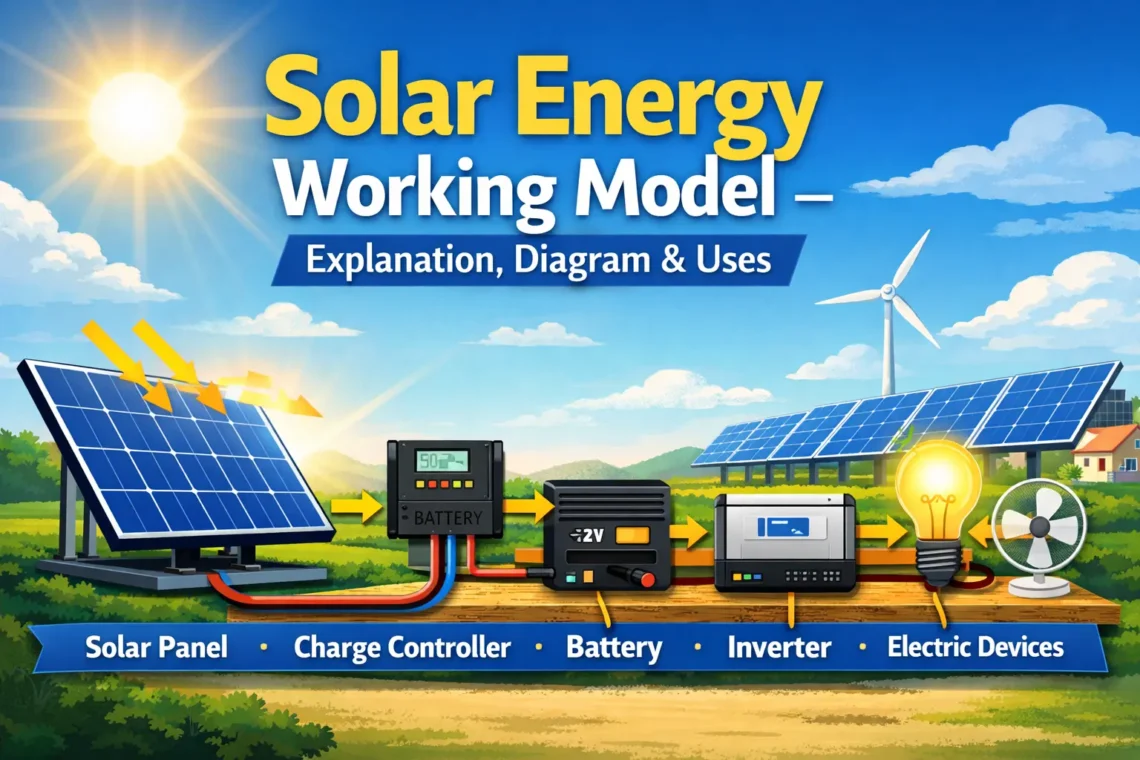
Every solar energy working model relies on a few essential components, each with a clearly defined role. Together, they form a complete energy conversion system.
Plain-language overview: each part either captures energy, moves it, stores it, or uses it.
Core components include:
- Solar panel: captures sunlight and generates DC electricity
- Charge controller: regulates voltage and protects batteries
- Battery (optional): stores energy for later use
- Inverter: converts DC into AC power
- Load: device that consumes electricity
Practical example: In an off-grid model, energy collected during the day is stored in a battery and used to power lights at night.
Reported in industry documentation, modern systems may add smart meters and monitoring apps, but the foundational model remains the same. This consistency makes the solar energy working model universally applicable—from a tabletop demo to a megawatt-scale plant.
Diagram-Based Explanation of Solar Energy Flow
Visualizing the Energy Path
A diagram is often the most effective way to understand a solar energy working model. It shows energy flow step by step, reducing complexity and improving clarity.
In plain terms, the diagram answers one question: where does the energy go next?
Typical diagram flow:
- Sunlight → Solar panel
- Panel → Charge controller
- Controller → Battery or inverter
- Inverter → Electrical load
Example: A labeled diagram in a textbook helps students trace energy movement and identify where losses may occur.
Educators and engineers alike rely on these diagrams to troubleshoot systems, explain efficiency issues, or plan upgrades. While diagrams simplify reality, they accurately reflect how real solar installations operate—just on a much larger scale.
Uses of the Solar Energy Working Model
Educational, Residential, and Industrial Applications
The solar energy working model isn’t just theoretical—it directly mirrors real-world applications across multiple sectors.
Plain-language summary: the same idea powers calculators, homes, and entire cities.
Common uses include:
- Education: science fairs, engineering training, awareness programs
- Residential: rooftop solar systems for homes
- Commercial: offices, factories, and malls
- Remote areas: off-grid power where electricity access is limited
Practical example: Rural clinics use solar setups to run medical equipment without relying on unstable grid power.
According to announced government renewable initiatives, scaled-up versions of this model are central to national solar missions. The small model you see in a classroom is essentially a blueprint for global energy infrastructure.
Advantages and Limitations of the Solar Energy Working Model
What the Model Shows—and What It Simplifies
While the solar energy working model is incredibly useful, it’s important to understand both its strengths and its limits.
Advantages highlighted:
- Clear demonstration of clean energy principles
- Easy to understand and replicate
- Low operating cost and zero emissions
Limitations often simplified:
- Weather-dependent performance
- Initial installation cost not fully shown
- Efficiency losses not always visible
Example: A model may show constant power output, while real systems fluctuate with clouds and seasons.
Still, as reported in educational research, these models remain one of the most effective tools for teaching renewable energy concepts without overwhelming complexity.
Frequently Asked Questions (FAQ)
Q1. What is a solar energy working model?
A solar energy working model is a simplified representation showing how sunlight is converted into electricity using solar panels and basic electrical components.
Q2. Is the solar energy working model accurate?
Yes, the principles are accurate, though real systems include additional components and efficiency considerations.
Q3. Can students build a solar energy working model at home?
Yes. With a small panel, wires, and an LED, students can easily build a basic model for learning purposes.
Q4. Where is the solar energy working model used in real life?
Its principles are used in rooftop solar systems, solar farms, street lighting, and off-grid power solutions.
Conclusion
The solar energy working model is more than a classroom experiment—it’s a window into how the world is rethinking power generation. By clearly explaining how sunlight becomes electricity, the model connects science, sustainability, and real-world impact in a way few technologies can. As solar adoption accelerates globally, understanding this model isn’t just educational—it’s empowering. Clean energy, after all, begins with understanding how it works.


